One or Two Main Compartments? Choosing a School Backpack Layout
Compare one shared main compartment with two separate zipped sections, then see which Vaschy layout suits the way you use your school supplies.
If reaching your calculator means lifting out a sweatshirt, another front pocket may not solve the problem. The decision is whether those belongings should share a main compartment.
Choose one main compartment when you want a shared packing area and can give smaller supplies a clear place. Consider two main compartments when you have two groups of belongings that you want to reach through separate openings. Neither arrangement is automatically better. The useful choice is the one you can explain, use and repack during an ordinary school day.
The two current Vaschy designs below show different layouts to consider. The suggested checks use your own belongings; they are not results from a hands-on test of the pictured bags.
Count storage areas, not zipper pulls
Two zipper sliders meeting on one track still close one opening. They do not establish that a backpack has two main compartments. Similarly, a front organizer pocket can provide a separate place for small supplies without being a second large packing area.
An internal file divider creates another distinction. It can give papers a place within the main compartment, but it is not the same as a second large section reached through its own zipper. It also should not be treated as a padded laptop sleeve unless the actual product documentation establishes that feature.
When a listing says multiple pockets, look for an open-bag photograph or a description that identifies each section. Trace where each zipper leads. Does it open the shared main area, a shallow front pocket or another large compartment?
If two bags look similar from the front, ask the seller: “Which openings lead to the two large compartments?” An answer about total pocket count does not settle that question.
Give the second compartment a specific job
Before deciding that two is better than one, finish this sentence: “I want to reach ___ without opening the space that holds ___.”
For example, a student might want class materials in one section and a dry change of clothes in the other. Another might keep the materials for a regular after-school activity together. These are possible arrangements to evaluate, not promises that the pictured backpacks fit those items.
A second section needs a repeatable job. If every item could go in either section, the extra opening may just become another place to search.
Understood's backpack organization guide recommends assigning categories of supplies to suitable storage areas. Use the student's habits to judge how much separation helps. Extra compartments do not guarantee an easier routine.
A student who already uses a pencil pouch and a small cable pouch may prefer to move those containers together through one main opening. Someone who wants a separate entry for a larger group may prefer two. Let the person carrying the bag make that comparison with their actual supplies.
Compare what each layout asks you to do
Use the same daily tasks to compare both layouts. These are points to check on the actual model, rather than fixed performance differences between all backpacks.
One shared main compartment
- Large items: Arrange them together in the main area, using any documented divider appropriately.
- Small supplies: A useful front pocket or a pouch may do the job.
- Daily access: Use the main opening, unless the item has another suitable pocket.
- A changed load: Reconsider positions within the shared area.
- What to check: Visibility, reach and the arrangement around the largest item.
Two separate main compartments
- Large items: Assign a purpose to each large section, then check the actual items in both.
- Small supplies: Small items still need a home; a second large section does not replace every organizer.
- Daily access: Use the opening for its assigned section, if the layout really provides independent access.
- A changed load: Check whether the changed group still suits its assigned section.
- What to check: Both entries, the space on each side and retrieval with both sections occupied.
Grade level alone does not tell you how many compartments to choose. Use the required school materials and the student's preferred routine. A college commuter with a small kit may prefer a different arrangement from a high-school student carrying several subject folders.
Check both sections together
A second compartment is another part of the same backpack. Do not read a whole-bag capacity label as the space available in each section, and do not assume the two sections are equally deep.
The way a partition behaves also matters. With permission to inspect a bag, put the usual items in both intended areas and see whether the arrangement changes access. Does a bulky object on one side make it awkward to return a flat item on the other? Does each zipper close normally with both sections in use?
Treat that as a question to try on the actual bag, rather than assuming every divider behaves alike. Neither an exterior measurement nor an empty interior photograph answers it completely. If you cannot inspect the bag, ask for usable compartment and entrance measurements for the items that matter to you.
Keep protection requirements separate from organization. Two fabric sections do not, by themselves, establish a leakproof barrier, insulation or impact protection. A second compartment should not become a reason to place an uncontained wet item beside school papers or electronics.
For the wider question of whether papers, lunch and the rest of the daily kit work together, use the school backpack packing checklist. This comparison helps you choose the layout to investigate first.
Compare two current Vaschy layouts
Compare these current product descriptions with their official galleries, then check your own kit before choosing. Displayed contents illustrate an arrangement; they do not establish what is included or prove fit for your belongings.

UltraLight Backpack: one main space with a file divider
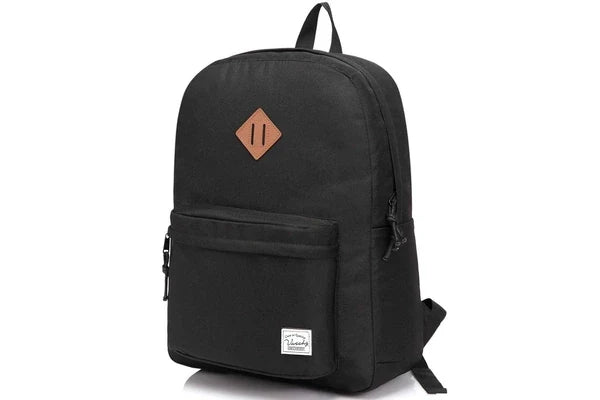
The Vaschy UltraLight Backpack in Black, SKU 16HS, is described as having one top-loading main compartment with a file divider. Its listing also identifies a front zipper pocket and two side water-bottle pockets.
That layout is worth comparing if you want most larger belongings reached through one main opening, with small supplies assigned elsewhere. Start with the divider: identify what you would put there and what would remain in the shared space.
Then look at the front pocket's opening. Could the small supplies you repeatedly need have a suitable place there, or would you use a separate pouch? Do not assume a particular pouch or bottle fits because its general category appears in the description.
The file divider is the important detail in this comparison. One main compartment can still have an internal way to separate papers. That is different from two large sections with separate zipped entries, and it is not proof of padded device protection.
Shop the Vaschy UltraLight Backpack in Black

Unisex Large Bookbag: two separate zipped sections
The Vaschy Unisex Large Bookbag in Black, SKU 178HS, is described as having two large separate zippered compartments. Its official detail gallery shows the main and second sections as distinct storage areas.
Use those views to work out which group you would assign to each section. Then check the entrance and usable space for both groups. The words two compartments do not tell you that a particular binder, clothing pouch or protected device will fit where you intend to put it.
Compare this layout when a separate entry has a clear purpose in your day. If one section would stay mostly empty while the other is crowded, reconsider the arrangement before choosing.
The gallery can help you identify the design, but it does not supply every usable interior measurement. If one particular item's fit is essential, ask Vaschy support about that item and the exact Black option before ordering.
Shop the Vaschy Unisex Large Bookbag in Black

Rehearse one change between classes
Rather than packing an imaginary perfect school day, choose one ordinary transition. You might put away a notebook and take out a calculator, or put away class materials and retrieve your dry activity kit. Use the actual objects you expect to carry.
With a bag you own, or one you have permission to inspect, try this short comparison:
- Give each item a place before closing the bag.
- Open the section you expect to use for that transition.
- Put the finished item away and take out the next one.
- Close the bag without moving unrelated items into temporary piles.
Notice the part that needs improvement. Opening the wrong section repeatedly suggests that the arrangement needs clearer roles. Lifting a pouch out to reach a notebook suggests checking its position or trying another layout. A zipper that needs force means the packing arrangement has not passed this check.
This is a suggested comparison, with no time target or promised result. Let the person carrying the bag decide whether the storage plan makes sense. If changing one item's position solves the problem, you may not need a different backpack at all.
Questions to settle before choosing
Does a double zipper mean two compartments?
No. Two sliders on the same zipper track can serve one opening. Look for two independently reached large spaces in the actual description and open-bag views.
Is a two-compartment backpack always bigger?
The number of sections does not establish their usable dimensions or the total size of the bag. Check the actual model and your required items. Compare layout and fit as separate questions.
Can a pouch make one compartment work like two?
A pouch can group belongings within a shared space, but you still reach it through that space unless the bag has another access route. Compare whether you want portable grouping or an independently reached large section.
Choose the separation you will actually use
Choose one main compartment if a shared area, useful smaller pockets and your own grouping system suit the day. Consider two when you can name a useful job for each section and the real items work in those places.
Compare the UltraLight's shared main area and file divider with the Large Bookbag's two separate zipped sections. Picture your ordinary class transition as you review the galleries.
Shop the UltraLight Backpack's one-main-compartment layout
Shop the Large Bookbag's two-compartment layout
If neither arrangement answers your needs, browse Vaschy backpacks and compare the actual openings and sections before selecting a style.


