Can a Backpack Be Your Personal Item? Check Before You Fly
Check the fare, packed measurements and stowage rules before treating an everyday backpack as your personal item on a flight.
You know where the headphones live in your school backpack. Bringing the same bag on a flight sounds simple, until you need to decide whether it counts as your personal item or your standard carry-on.
A backpack can serve as a personal item when your ticket permits it, the packed bag meets the airline's personal-item requirements, and it can be stowed as required for your flight. Check those conditions separately. A bag that works as an overhead carry-on is not automatically suitable for the personal-item slot.
Start with the backpack you own and the booking in front of you. Decide which allowance it would use before packing a second bag.
Check your ticket before choosing a bag category
Open the baggage information attached to your booking. Find the allowance for the fare and itinerary you actually bought, including any connecting flights or different operating airlines.
Write down three things:
- Whether a personal item is included.
- Whether a separate standard carry-on is included.
- The applicable size, stowage and any other baggage conditions.
If you plan to bring a backpack and a rolling suitcase, assign each one to an allowance in the booking. If you cannot identify an included category for the second bag, resolve that question with the airline before packing it.
Check additional-item exceptions directly with the airline if they apply to your trip. This guide concerns an ordinary backpack; it does not summarize allowances for medical equipment, infant supplies or other special items.
Compare the rules for your actual flight
Here are two current examples, checked on October 14, 2026. They illustrate why one generic personal-item size is not a dependable shopping rule.
| Airline | Published personal-item maximum |
|---|---|
| American Airlines | 18 x 14 x 8 in / 45 x 35 x 20 cm |
| Air Canada | 33 x 43 x 16 cm / 13 x 17 x 6 in |
American Airlines says a personal item must fit under the seat in front of you. Its published policy permits one personal item and one carry-on when they meet the requirements, and notes that some planes and airports can impose additional restrictions.
Air Canada labels its dimensions D x W x H and includes handles and wheels. Its Economy Basic tickets bought on or after January 3, 2025, include only a personal item on specified routes within Canada and to or from the U.S., Mexico, Central America and the Caribbean. The policy gives an exception for onward international connections and explains that a partner airline's rules may apply.
Use each airline's dimensions diagram to compare your bag with the measurements in its policy. These two examples do not establish a rule for another carrier or confirm the space at your particular seat.
Keep the policy link and fare name with your booking details. Check the live policy again before departure; an old screenshot may describe a different fare or an earlier rule.

Measure the backpack with your flight items inside
A bag's listed capacity describes volume. It does not tell you the three outside measurements of the bag you will present at the airport.
Empty out school supplies first. Pack the items you intend to take on the flight, close the compartments normally and place the bag on a flat surface. Then record its greatest outside height, width and depth.
Include the parts that change its outline: a filled front pocket, a bottle in a side pocket, a rigid case and protruding handles. Check the airline's measuring instructions for the relevant category rather than measuring only the main fabric panel.
Use a ruler or tape without pressing a bulging pocket flat. Record the outline the packed bag actually holds, including that front pocket you filled at the last minute.
Try one change at a time. Remove an optional bulky item, repack and measure again. Keep any item you move within the baggage arrangement your ticket allows; a separate pouch is not automatically an extra permitted bag.
For example, imagine a student measuring a backpack before adding a sweatshirt and a filled front pouch. The later load may have a different outline. This hypothetical example is why the final packed state matters more than yesterday's measurement.
A home measurement is preparation, not an airline acceptance test. Follow the carrier's sizer, stowage instructions and staff guidance on the day.

Plan what you can reach without unloading the bag
Once the packed outline looks suitable, consider how you will use the bag during the journey. Being able to close it is only part of the arrangement.
As a suggested practice exercise, place the bag in front of a chair and retrieve a book or headphones. Can you find them without removing your whole travel kit? Put them back and check that the zipper closes normally.
Give the things you use at different stages a clear home. For example, keep a boarding document accessible before sitting down, and put headphones where you can find them afterward. Use a pouch if it helps; a familiar pocket may be enough.
Take account of what happens after you retrieve something. A large pouch may be easy to pull out but awkward to return to a tightly packed compartment. Recheck the bag's outline after putting it back.
This exercise helps you compare access arrangements. The space beneath a household chair does not reproduce an aircraft seat or confirm underseat fit. Use the airline's requirements and follow the cabin crew's directions for actual stowage.
Check the contents separately from the bag
Baggage allowance and security screening answer different questions. A backpack that meets a size rule can still contain an item that needs different packing or cannot go through a checkpoint.
For flights originating in Canada, CATSA's “What can I bring?” tool lets you check individual items. CATSA explains that its list concerns Canadian departures and that the screening officer makes the final checkpoint decision.
For U.S. screening questions, use the TSA resources linked from American's security and packing guidance. Check current instructions for the items you actually carry, including electronics, liquids and batteries.
Do this review before finalizing the load. Moving an item to a different bag may change both bags' measurements. If a bag must be checked, ask the airline which contents must be removed or handled separately. Do not assume that everything acceptable in the cabin can stay in a checked bag.
This article does not grant permission for a particular item or replace the screening authority's instructions.
What to check on a Vaschy ClassicPack
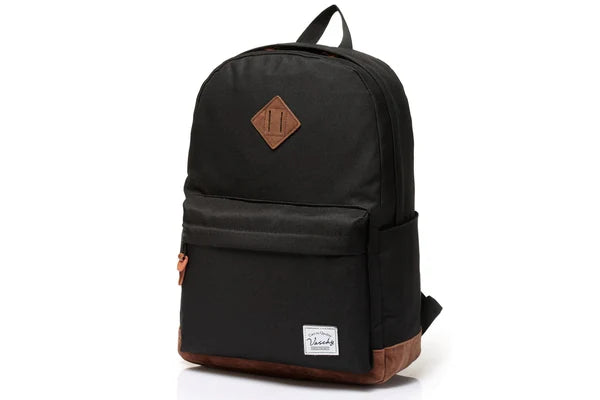
If you want to compare a daily backpack's organization with your travel routine, look at the actual pocket layout. The Vaschy ClassicPack listing describes a main compartment with double-zipper closure, an exterior zipper pocket, bottle pockets on both sides, internal zipper storage and a padded device pocket.
The Black option is SKU 01HS. Its pocket arrangement gives you specific places to inspect when planning your load:
- Compare the front pocket's access with the small items you will retrieve.
- Check how a bottle changes the bag's outside width.
- Try your device with its protective case and the other items you intend to pack.
- Close the loaded main compartment without forcing the zipper.
Try the device and its case together before relying on the padded pocket. Then measure the complete packed bag for the flight; the gallery cannot supply those measurements for you.
We have not verified this model as a personal item for a particular carrier. If that is the main reason for your purchase, confirm the exact model's measurements and your flight's requirements before choosing it. Use Contact Vaschy for a specific product question.
Shop the Vaschy ClassicPack in Black →
Compare the pictured pockets with the arrangement you want for everyday use. Confirm the flight measurements separately before making a travel-specific purchase.
If the backpack misses the limit, change the plan
Identify what fails before replacing the bag. Is one packed dimension too large? Does the ticket exclude the extra cabin bag you planned to bring? Or does the proposed arrangement depend on storage you have not confirmed?
A lighter packing plan may change an overfilled bag's outline. Remove an optional item and measure again. That will not necessarily change a structured section or make a rigid device smaller.
Using the backpack as your standard carry-on may be an alternative only when the booking includes that category and the bag meets its requirements. Confirm where the rest of your belongings will go before relying on this option.
If the backpack's shape or the permitted allowance still does not work, compare a different bag or revise the baggage booking with the airline. Do not plan around squeezing past a check or finding unused overhead space.
Keep enough time to resolve uncertainty before departure. A useful question for the airline includes the actual itinerary, fare and packed measurements, rather than just the backpack's brand or capacity.
Keep a short record for this trip
Use a note that connects your measurements to the booking. For example, a hypothetical trip record could contain:
- Booking: fare name, operating airline and connection details.
- Allowance: the bag categories confirmed for this itinerary.
- Packed bag: outside measurements and the load used when measuring.
- Contents check: items whose screening or packing instructions you reviewed.
- Still to confirm: any unanswered carrier or product question.
Update the note if you change the load. Adding a souvenir or moving a jacket from another bag can make the return trip different from the outward one.
Keep the record short enough to update when the packing changes. It helps you remember what you checked; the airline still determines whether the bag meets its requirements.
Questions travelers ask
Does a school backpack count as a personal item?
It can, when it meets the requirements for that allowance on your actual booking and can be stowed as required. “School backpack” is a use description, not an airline baggage category.
Can I bring a backpack and a suitcase?
Check the categories included in your ticket and the requirements for both packed bags. Do not assume every fare permits a personal item plus a separate standard carry-on. The examples above show why the itinerary and fare matter.
Does a 20-liter or laptop-size label prove airline fit?
No. Capacity and device labels do not establish the packed bag's outside dimensions, the available stowage space or your fare's allowance. Measure the final load and compare it with the applicable policy.

Choose a bag after confirming the trip
If the bag you own meets the confirmed conditions, use it. If you need another, keep your trip requirements beside you while you compare its dimensions and pockets.
For another ClassicPack color, the pictured Burgundy option is SKU 01JH. View its current listing and confirm any measurement question before choosing it for a flight.
Shop the Vaschy ClassicPack in Burgundy →
Before ordering, read Vaschy's returns and refunds policy. Standard-return requests have a 30-day window after delivery and require unused, original-condition goods and proof of purchase. Approved standard returns have a 10% handling fee, customer-paid return shipping and eligibility exclusions. Plan your comparison within those terms rather than assuming an airport-use trial is return eligible.
Shop current Vaschy ClassicPack colors →
Images are genuine photographs from Vaschy's official ClassicPack gallery. They illustrate the product, not an aircraft fit test, security approval or included travel supplies.


